


Blog
How to Use a Finger Pulse Oximeter: 5 Steps
A finger pulse oximeter is now a common thing to find at home, often with an older relative. The question that keeps coming up is not how it works but whether to trust the number. Measure twice in a row and you can get two different readings.
This guide is about the measurement itself: how to get a steady reading, what affects it, and what the research actually says about nail polish. It gives no “normal” number to compare yourself against, because reading the number is your doctor’s job.
What does a finger pulse oximeter measure?
The U.S. Food and Drug Administration describes it on its Pulse Oximeter Basics page: a device that usually clips onto a fingertip and uses a beam of light to estimate the oxygen level in your blood (oxygen saturation) and your pulse rate. The key word is “estimate”. The device reads through the skin and does not take a blood sample.
Most devices show two or three numbers. The main one is oxygen saturation, shown on screen as SpO2 in percent. The second is pulse rate, shown as PR. Some also show a signal strength indicator.
The World Health Organization pulse oximetry training manual adds a useful detail: the pulse indicator tells you the device has found a pulse. With no pulse signal, any number on the screen means nothing.
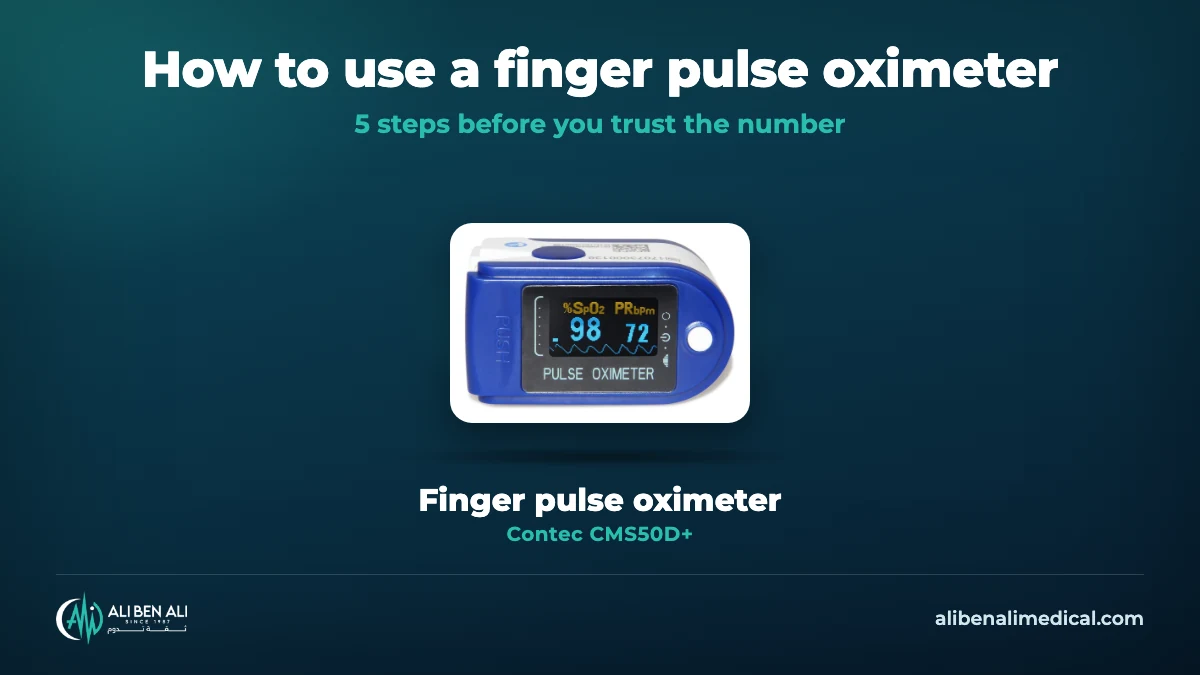
The Contec CMS50D+ is one example of this type. Its page explains the idea in one line: the sensor sends light through the finger, measures what comes through, and works out oxygen saturation and pulse from the difference. It shows both numbers along with a bar graph and a pulse waveform, so you can see the signal is steady before you read the number.
5 steps before you trust the number
The FDA starts with two points before any step: follow your doctor’s advice on when and how often to measure, and follow the manufacturer’s instructions. Then, to get a steady, reliable reading at home:
- Keep your hand warm and relaxed, below heart level. Rest it, open and loose, lower than your heart while the device is on your finger.
- Remove nail polish from that finger. The FDA says to take any polish off the finger you are measuring on.
- Stay still. Do not move the hand or the part of the body the device is on during the measurement.
- Wait for the number to settle. Give it a few seconds until it stops changing and shows one steady number.
- Write down the number, the date and the time. That lets you follow any change and give your doctor exactly what you saw.
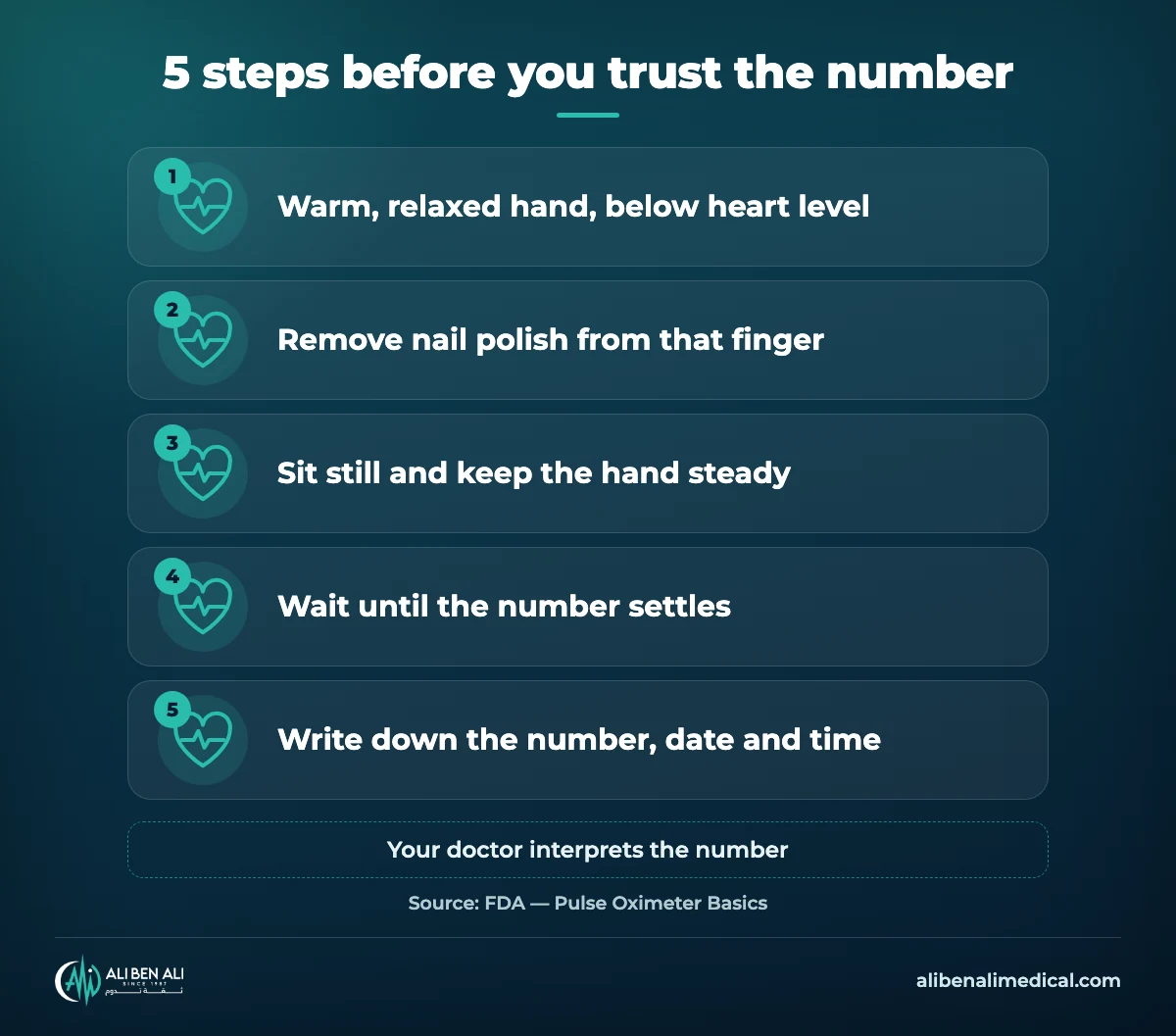
The fifth step is the one people skip. A single number with no time on it tells a doctor little, while a series of numbers with dates shows the picture. Even if your device stores readings, as the CMS50D+ page says it does, with upload to a computer, a handwritten note with the number and the time is the easiest thing to bring to the appointment.
Two more practical points come from the WHO manual. First, the sensor must sit on the finger properly, neither loose nor squeezing. Second, if you are also measuring blood pressure, do not put the oximeter on the same arm, because the inflating cuff cuts off the signal.
Nail polish: what did the research find?
This is where the popular advice is simpler than the evidence. Some studies found a clear effect and some found a small one. The difference seems to come down to the colour and type of polish.
A study from Nigeria published in 2013 (Desalu and colleagues) tested 50 non-smoking volunteers. Fingers were painted with clear, red, brown and black polish, one finger had an acrylic nail fitted, and the matching finger on the other hand was the comparison. Readings were taken with a device called Lifebox.
| Nail type | Fingers that gave a reading | Average reading vs. the other finger |
|---|---|---|
| Clear polish | 100% | No significant difference |
| Red polish | 100% | No significant difference |
| Acrylic nail | 100% | No significant difference |
| Brown polish | 64% | Lower, a significant difference |
| Black polish | 12% | Lower, a significant difference |
The researchers concluded that dark polish should be removed before measuring so the reading comes out right.
A second study, from Iran in 2019 (Yeganehkhah and colleagues), tried 10 colours of glittered polish on 30 healthy students. Dark green and purple did not change the reading significantly. The other colours lowered it by a statistically significant amount, but by less than 2%, which the authors judged to be of no clinical importance in healthy people.
So the two studies do not point the same way, and both were done on healthy people with devices other than yours. The practical answer does not need the argument settled: as the FDA says, remove the polish from the finger you will measure on, or measure on a bare finger.
Light, movement and cold hands
The FDA says any device can give an inaccurate reading, and lists factors that can affect accuracy:
- Poor circulation.
- Skin colour and skin thickness.
- Skin temperature.
- Current tobacco use.
- Nail polish.
On skin colour in particular, the FDA says current evidence points to differences in accuracy between lighter and darker skin, and that this is a limitation of these devices to keep in mind.
Cold: a cold hand gets less blood flow at the fingertips. The WHO manual says the device may fail to pick up a signal if the person is very cold, and that gently rubbing the finger can bring the signal back. That is why step one is to warm the hand first.
Movement: shivering or moving the hand makes it harder for the sensor to catch the pulse, according to the same manual. Sit down, rest the hand on your lap or a table, and wait.
Light: the CMS50D+ page says the device is built to resist ambient light, with less than ±1% difference between a reading in daylight indoors and one in a dark room. It gives the same advice as above: measure with the hand still.
Who interprets the number?
The FDA is clear: if you monitor oxygen at home, also keep track of your symptoms and how you feel, not just the number. Talk to your healthcare provider if you are worried about a reading, or if symptoms are severe or getting worse. A device reading is read together with other information, and only a healthcare provider can judge a medical condition.
When the family asks “is this number good?”, the honest answer is that its meaning differs from person to person. That is why the CMS50D+ page itself says the doctor decides the right level for each patient, and that the device’s alarm limits are set as the doctor advises. The device measures and displays; the doctor reads and decides.
If what you need is more than a single reading on one screen, for a clinic or hospital, those are different devices, in the patient monitors category. The choice among them belongs to your doctor and the medical team.
Frequently Asked Questions
Usually because the reading was taken before it settled, or the hand moved or was cold. The FDA says to wait until the number stops changing and shows one steady value, with the hand warm, still and below heart level.
This guide does not give threshold numbers. What a number means depends on each person’s condition, and your doctor is the one who interprets it. Write your readings down with dates and show them to your doctor.
The research is mixed: one study found brown and black polish lowered the reading, and a study on glittered polish found a difference of less than 2%. The FDA says to remove polish from the finger you measure on, and that is the simplest fix.
According to the product page, it runs on 2 AAA batteries, warns you when the battery is low, and switches itself off within 5 seconds when no finger is in the device.
Yes, the Contec CMS50D+ is registered with the Egyptian Drug Authority.
The Contec CMS50D+ carries a 2-year warranty from Ali Ben Ali from the date of purchase, as stated on the product page. For any question, call our hotline on 01212333328.
References
- U.S. Food and Drug Administration. Pulse Oximeter Basics. Consumer Update, content current as of 03/26/2025 — fda.gov/consumers/consumer-updates/pulse-oximeter-basics
- World Health Organization. Pulse Oximetry Training Manual. WHO Patient Safety, 2011 — cdn.who.int (PDF)
- Desalu I, Diakparomre OI, Salami AO, Abiola AO. The effect of nail polish and acrylic nails on pulse oximetry reading using the Lifebox oximeter in Nigeria. Niger Postgrad Med J. 2013;20(4):331–5. PubMed PMID 24633278 — pubmed.ncbi.nlm.nih.gov/24633278
- Yeganehkhah M, Dadkhahtehrani T, Bagheri A, Kachoie A. Effect of Glittered Nail Polish on Pulse Oximetry Measurements in Healthy Subjects. Iran J Nurs Midwifery Res. 2019;24(1):25–29. PubMed PMID 30622574 — doi:10.4103/ijnmr.IJNMR_176_17
- Contec Medical Systems. CMS50D+ Pulse Oximeter (manufacturer page) — contecmed.com/productinfo/602632.html
- Ali Ben Ali Medical Equipment. Contec CMS50D+ pulse oximeter product page — alibenalimedical.com
Medical devices are used in accordance with the treating physician’s instructions and the accompanying technical catalogue.
All devices are covered by the official warranty of Ali Ben Ali Medical Equipment.


