


Blog
FVC and FEV1 Explained: What a Spirometer Measures
A lung function report is full of letters: FVC, FEV1, a ratio between them, and a few more numbers beside them. Anyone who sees one for the first time asks the same simple question: what do these letters mean, and how did the device measure them?
This article explains the two main numbers of a spirometry test in plain English, how the test itself is done, and why reading the result belongs to the doctor. It explains terms. It is not a guide to interpreting anyone’s own report, and it gives no “normal” number to compare yourself against.
What does a spirometer measure?
Lung function tests are a group of tests that measure how you breathe and how well your lungs work. The most familiar and most widely used is spirometry. The U.S. National Library of Medicine’s MedlinePlus describes it as a test that measures how much air you breathe out of your lungs, and how fast you breathe it out.
So a spirometer does not take a picture of the lungs and cannot see inside them. It measures air moving out over time. Several numbers come from that one measurement, and two matter most: FVC and FEV1.
The international standard for how the test is performed, from the device to the operator, was set out in a joint statement by the American Thoracic Society and the European Respiratory Society in 2019 (ATS/ERS 2019). It describes spirometry as the most common lung function test, and says the aim of the standards is to improve the accuracy, precision and quality of the measurement, and the experience of the person taking the test.
FVC explained: all the air, to the very end
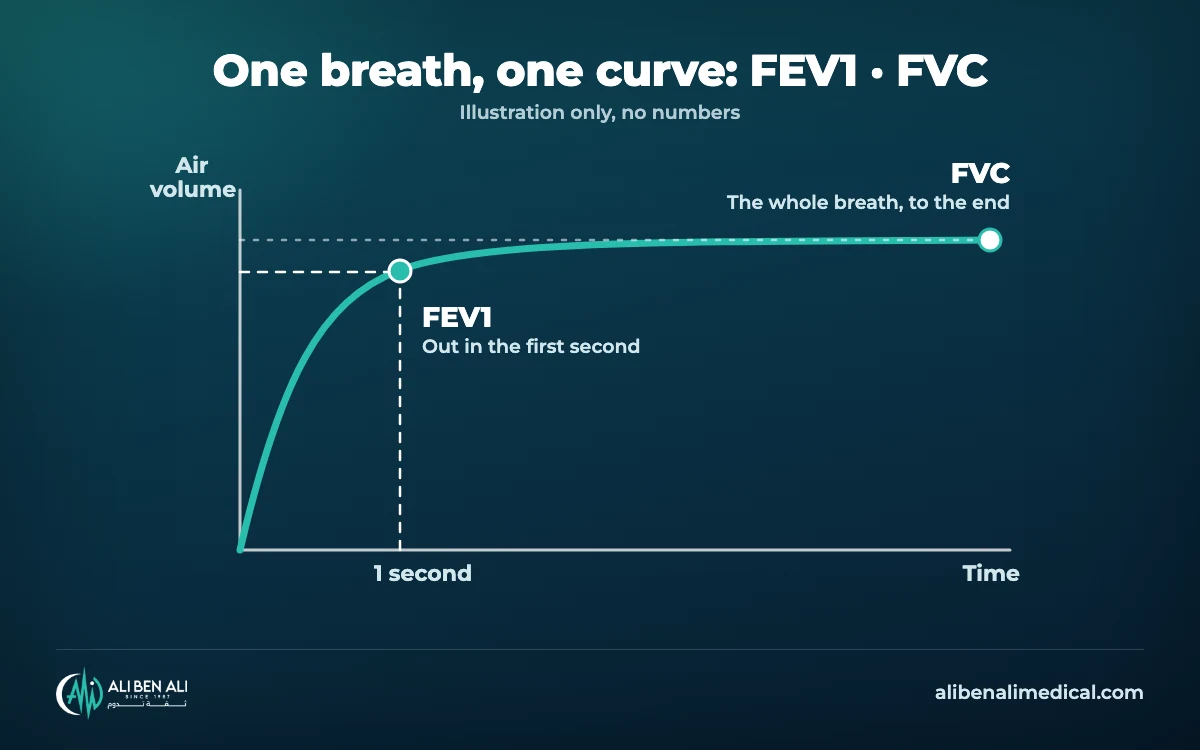
FVC stands for forced vital capacity. In the test you take the deepest breath you can, then blow it all out into the device as hard and as fast as you can, until your lungs are empty.
The volume of air that comes out in that one breath, from start to finish, is the FVC. It answers the question: how much air can you blow out forcefully after a full breath in?
FEV1 explained: what comes out in the first second
FEV1 stands for forced expiratory volume in one second. It comes from the same breath as the FVC, but the device looks at only one part of it: how much air left your lungs in the first second.
The difference is that FVC measures how much, while FEV1 measures how much in the first second, so speed is part of it. The diagram below shows the idea on a single curve, with no numbers.
The FEV1/FVC ratio, and who reads it
A spirometer also works out the ratio of FEV1 to FVC, written FEV1/FVC in the report. It says what share of the whole breath left in the first second.
These numbers are not read on their own as absolute values. According to MedlinePlus, your result is compared with the values predicted for people of the same age, sex, height and weight, and expressed as a percentage of those predicted values. Reference values can also differ a little from one laboratory to another, depending on how each one defines them. That is why MedlinePlus says plainly to talk with your health care provider about what your own results mean.
Lung function tests are also used together with other tests and information to assess and follow the lungs, not by themselves. The person who reads the report and links it to the examination and medical history is the doctor. The device measures; the doctor reads.
Why would a doctor order a spirometry test?
MedlinePlus lists many reasons to order lung function tests, and not all of them are lung disease. They include:
- finding the cause of shortness of breath.
- checking whether exposure to chemicals at work has affected lung function.
- checking lung function before surgery.
- assessing the effect of medicines, and following how a condition and its treatment are going.
Some people are asked to have the test as part of a routine check-up, according to MedlinePlus. So the test is done in chest clinics, and also in occupational-health clinics or before an operation. The doctor decides when it is needed and for whom.
How is a spirometry test done?
The basic steps, as MedlinePlus describes them:
- You sit in a chair, and a soft clip is placed on your nose so that you breathe through your mouth only.
- You close your lips tightly around the mouthpiece attached to the device.
- You take a deep breath in, then blow into the device as hard and as fast as you can.
- Sometimes you are asked to inhale a medicine that opens the airways and repeat the test, so the difference can be seen.
One point matters for accuracy: if your lips are not sealed well around the mouthpiece, the result may not be accurate. The test involves hard, fast breathing, so you may feel breathless, dizzy or have a brief cough.
Before the test, MedlinePlus advises not eating a heavy meal, and not smoking for 4 to 6 hours beforehand. If you use inhalers or other breathing medicines, you will be told whether you need to hold them back before the test. Some people should not have the test, for example after a recent heart attack or with certain other heart conditions; the doctor assesses that before ordering it.
Handheld spirometer or a lab test?
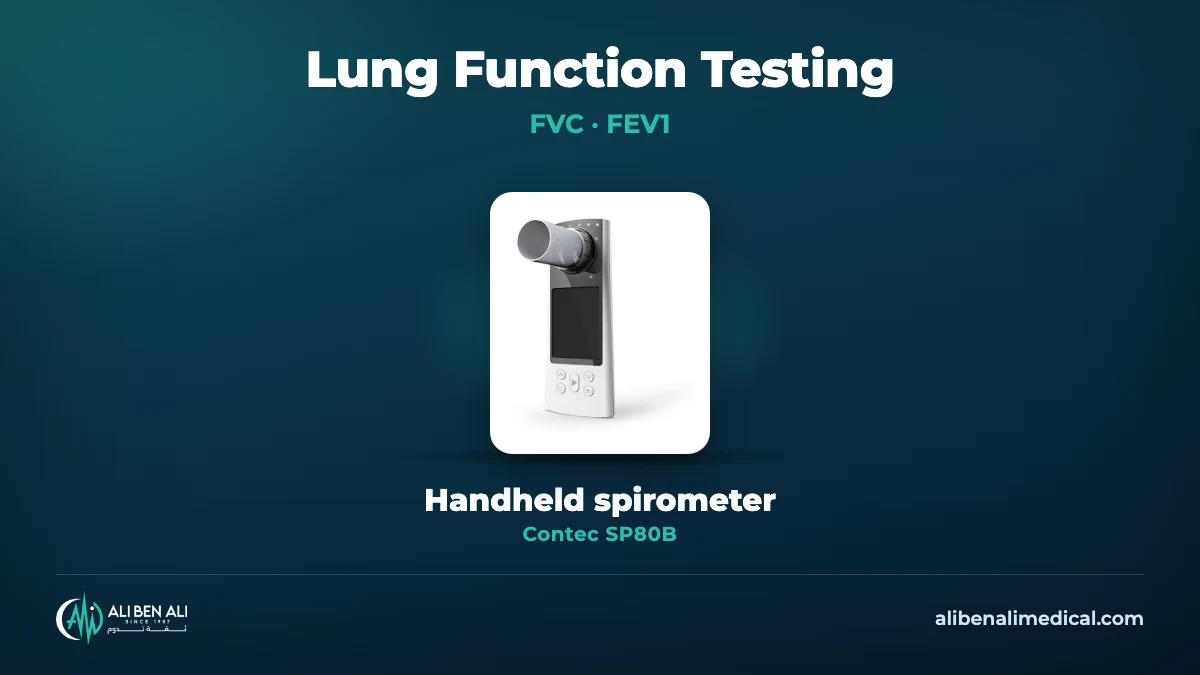
A spirometer can be a small handheld device. One example is the Contec SP80B handheld spirometer. Its product page describes a small handheld unit that weighs 190 g and runs a test with one button.
According to the product page, the device measures:
- FVC, FEV1 and the FEV1/FVC ratio.
- PEF, the peak speed of the air as you blow out.
It compares each reading with the person’s predicted value once their details are entered. It also has an expiratory-time indicator that shows when to keep going, a calibration function, storage for up to 9999 cases with review, and transfer of results to PC software by Bluetooth or USB cable. The page itself states that interpreting the result is the physician’s responsibility.
Some lung function tests, on the other hand, cannot be done with a handheld device. MedlinePlus explains that the most accurate way to measure total lung volume is body plethysmography, done while sitting inside a sealed, clear booth, and that there is also a test of gas diffusion (diffusion capacity). These are laboratory tests, and spirometry is only one of them.
So the choice between them is not a comparison of two devices. It is a question of which test the doctor or the centre needs to perform, and that decision belongs to the doctor.
Frequently asked questions
FVC is the volume of air you blow out forcefully after the deepest breath in, from the start of the breath to its end. How your own value reads is for your doctor to say.
FEV1 is the amount of air that left your lungs in the first second of that same breath. It differs from FVC in that it measures speed as well, not only the amount.
No. According to MedlinePlus, your result is compared with predicted values for the same age, sex, height and weight, and reference values can differ from one laboratory to another. Ask your doctor what your own result means.
MedlinePlus advises not eating a heavy meal and not smoking for 4 to 6 hours beforehand. If you use inhaled medicines, your doctor will give you specific instructions.
According to its product page, it measures FVC, FEV1, the FEV1/FVC ratio and PEF, compares each reading with the person’s predicted value, and stores up to 9999 cases, which it sends by Bluetooth or USB.
The Contec SP80B carries a two-year warranty from Ali Ben Ali from the date of purchase, according to its product page. For any question, call our hotline on 01212333328.
References
- Graham BL, Steenbruggen I, Miller MR, et al. Standardization of Spirometry 2019 Update. An Official American Thoracic Society and European Respiratory Society Technical Statement. Am J Respir Crit Care Med. 2019;200(8):e70–e88. PubMed PMID 31613151 — doi:10.1164/rccm.201908-1590ST
- MedlinePlus (U.S. National Library of Medicine). Pulmonary function tests — medlineplus.gov/ency/article/003853.htm
- MedlinePlus (U.S. National Library of Medicine). Lung Function Tests — medlineplus.gov/lab-tests/lung-function-tests
- Ali Ben Ali Medical Equipment. Contec SP80B handheld spirometer product page — alibenalimedical.com
Medical devices are used in accordance with the treating physician’s instructions and the accompanying technical catalogue.
All devices are covered by the official warranty of Ali Ben Ali Medical Equipment.


