


Blog
How to Choose a Home Hospital Bed: Electric or Manual
When someone at home spends most of the day in bed, the question changes from “which bed should we buy” to “which bed suits this person, this room and whoever helps them”. A bed that does not fit the situation can tire the patient and the person caring for them, and a bed that fits makes many daily tasks easier.
This guide walks through the questions to ask before you choose: electric or manual, what “3 functions” means, side rails, wheels, and bed safety at home. It does not replace your doctor’s or nursing team’s view of what the patient needs; the decision is your doctor’s.
Before you choose: who will use it and who will help
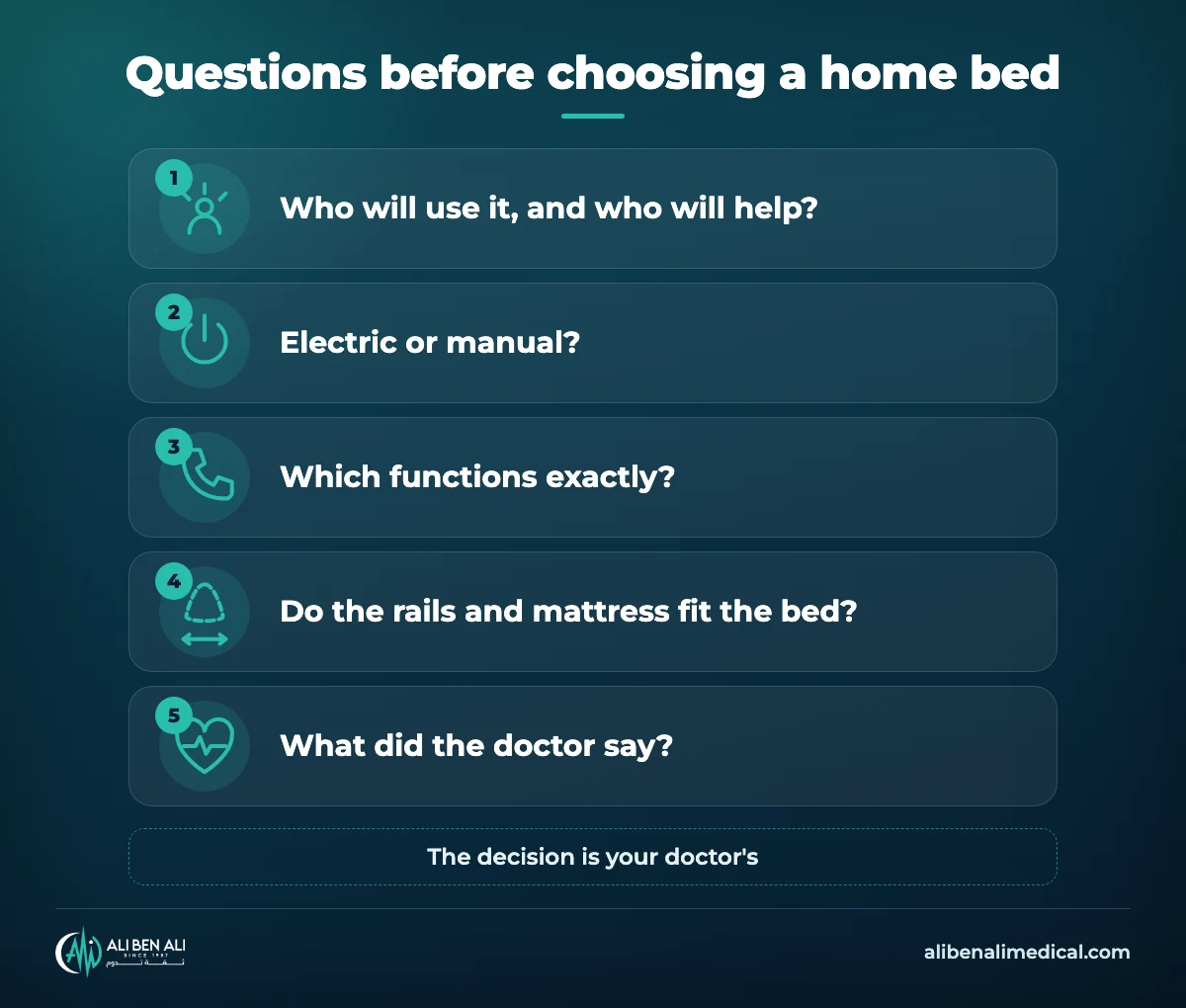
Start with the people, not the bed. Ask yourself:
- Can the person who will sleep in it move on their own, or do they need someone to turn them and help them sit up?
- Who will care for them most of the time: a family member, or a nurse?
- How long will they spend in the bed each day, and has the doctor asked for a particular position for sleeping or sitting?
- The room itself: is there space around the bed for whoever helps? Is there a power socket nearby if the bed is electric?
These answers shape every other choice. And any question about the right body position or about side rails is settled with the doctor after they assess the patient.
Electric or manual?
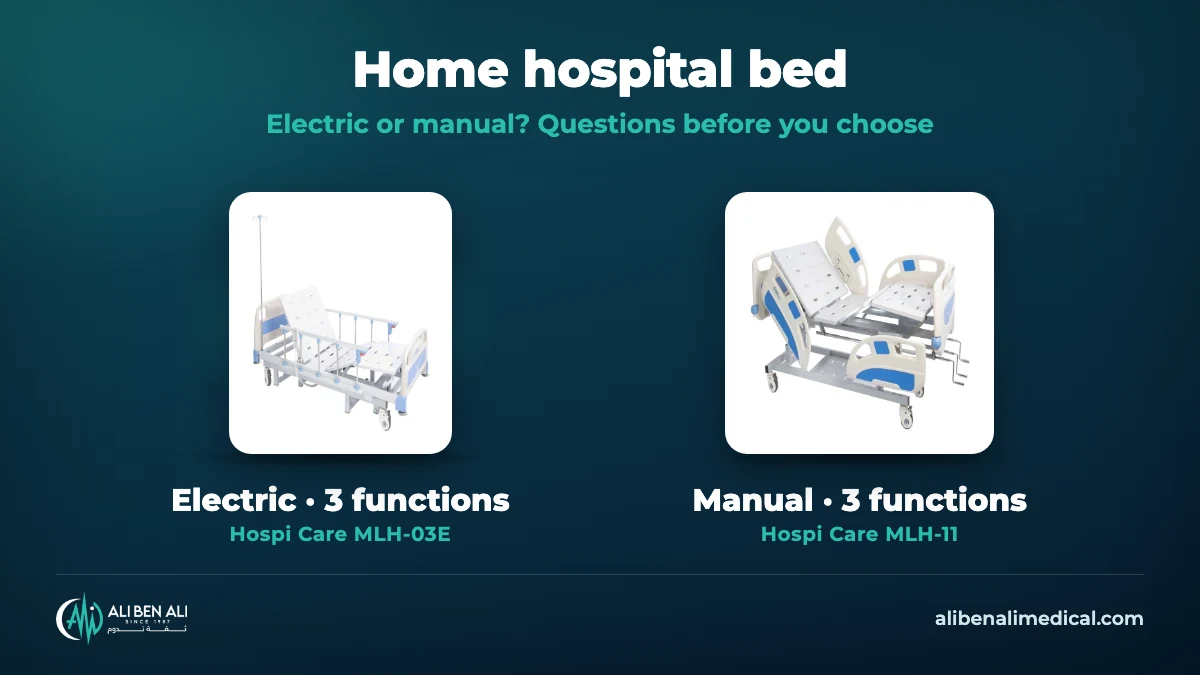
The basic difference is who moves the bed and how. Take two beds on our site from the same brand, Hospi Care, both with 3 functions:
- The MLH-03E electric hospital bed, 3 functions, low height: its page describes an electric bed with an adjustable, very low height. Its specification lists aluminium side rails, a CPR button, a stainless steel I.V. pole, a urine bag holder, and 125 mm noiseless castors with brake.
- The MLH-11 manual hospital bed, 3 functions: its page describes a practical-use bed with a manual CPR system, a stainless steel I.V. pole, a urine bag holder, and detachable ABS head and foot boards supplied with bumpers.
In practice, with an electric bed the person can often change position without waiting for someone, which matters if they sit up and lie down several times a day. With a manual bed, someone has to be beside them to adjust it, and no mains power is needed.
The U.S. Food and Drug Administration (FDA) guide on modifying bed systems and reducing the risk of entrapment says, in its purchasing section, that electric beds with adjustable height may be the right choice for care staff and for patients who need closer attention. It is written for healthcare facilities, but the idea carries over to the home: think about the person giving care as much as the person receiving it.
Other models, electric and manual, with different numbers of functions, are in the hospital beds category on the site. The bed type is chosen according to the patient’s needs, and the decision is your doctor’s.
Functions: what does “3 functions” mean?
A “function” on a hospital bed is a part or position of the bed that can be adjusted. So “1 function”, “2 functions” or “3 functions” is the number of things you can change about the bed’s position.
The number alone is not enough. Which parts exactly move differs from model to model. For these two beds the specification lists a backrest that tilts to 75º and a knee rest that tilts to 50º, and the MLH-03E page also lists a height adjustment. Ask the direct question when you confirm the model: what exactly are the three functions? And compare the answer with what your doctor asked for.
Side rails: what to ask
Side rails are the barriers along the side of the bed. At home the point is that the rails are part of the bed and compatible with it and with the mattress.
The FDA defines the “bed system” as the frame, the mattress, the rails and any accessories, provided they are compatible with each other, and advises checking with the manufacturer about the compatibility of bed components. It also says that a mattress of suitable size (length, width, thickness and how much it compresses) helps reduce gaps around the rails.
Does the person need rails at all, and should they stay raised? The FDA guide says the decision to reduce or remove rails should only be made after a proper assessment of the patient and with clear alternatives in place. So this is not a matter of appearance; the decision is your doctor’s and the nursing team’s.
Wheels, brakes and moving the bed
Wheels matter if the bed will be moved around the home, or if you need to pull it away from the wall to clean or to help the patient from both sides. The question to ask before buying: do the wheels have brakes, and how many of them lock? The bed must stay still when someone sits on it or gets up from it. The MLH-03E specification lists 125 mm castors with brake; the MLH-11 page does not mention castors, so ask when you confirm the model.
Height is part of the same topic. The MLH-03E is described as a low-height bed. The FDA guide lists adjustable low-height beds among the things that may be considered, in the part about alternatives when the use of rails is being reduced. That also comes back to assessing the patient.
Before the bed arrives, measure the room door and the corridor, and make sure there is room beside the bed for whoever helps the patient get up or sit down.
Bed safety at home: gaps around the rails
The FDA has a full page on hospital beds, and its main subject is “entrapment”: a part of a person’s body getting caught in a gap inside the rail, between the rail and the mattress, or between the bed and the head or foot board. The guidance covers beds in hospitals, nursing homes and private homes.
The gap locations the guide describes:
- Openings within the rail itself.
- The space between the rail and the mattress.
- The space under the rail.
- The space between split rails.
- The space between the rail and the head or foot board.
According to the guide, the people who most need attention here are older people, especially those who are frail, confused or unsteady in their movement. So the practical steps at home are simple:
- Use a mattress that suits the bed’s size, and ask about this before buying.
- If you add an air mattress or a mattress on top of the mattress, know that it can change the gaps. The FDA advises that an extra mattress goes on a bed that meets the recommended size limits, and checking with the manufacturer.
- Any accessory added to the bed should not open a new gap.
- Talk to the doctor or nursing team about the rails: whether they are needed and how they should be used.
The point here is not to frighten anyone. The bed, the mattress and the rails are one system, and they need to be chosen together.
Frequently Asked Questions
An electric bed is adjusted with a control, so the person can often change position themselves, but it needs mains power. A manual bed is adjusted by hand and needs someone beside the patient. Choose by who will use it and who will help, and leave the patient’s needs to your doctor.
It means the bed has 3 parts or positions that can be adjusted. Exactly which parts differs from model to model, so ask about them when you confirm the model.
That is decided after assessing the patient with the doctor or nursing team. The FDA guide says reducing or removing rails should only happen after a proper assessment and with clear alternatives.
One whose length, width and thickness suit the bed. The FDA says a suitable mattress helps reduce gaps around the rails, and advises checking with the manufacturer about compatibility of bed components.
The page of each bed lists its specifications, and the exact model supplied is confirmed with you before the order, on WhatsApp or by phone. Call our hotline on 01212333328.
References
- U.S. Food and Drug Administration (FDA). Hospital Beds — fda.gov/medical-devices/general-hospital-devices-and-supplies/hospital-beds
- Hospital Bed Safety Workgroup / FDA. A Guide for Modifying Bed Systems and Using Accessories to Reduce the Risk of Entrapment (2006) — fda.gov/medical-devices/hospital-beds/guide-modifying-bed-systems-and-using-accessories-reduce-risk-entrapment
- Ali Ben Ali Medical Equipment. Electric Hospital Bed 3 Functions Low Height Hospi Care MLH-03E product page — alibenalimedical.com
- Ali Ben Ali Medical Equipment. Manual Hospital Bed 3 Functions Hospi Care MLH-11 product page — alibenalimedical.com
Medical devices are used in accordance with the treating physician’s instructions and the accompanying technical catalogue.
All devices are covered by the official warranty of Ali Ben Ali Medical Equipment.