


Blog
How to Clean a Nebulizer After Every Session
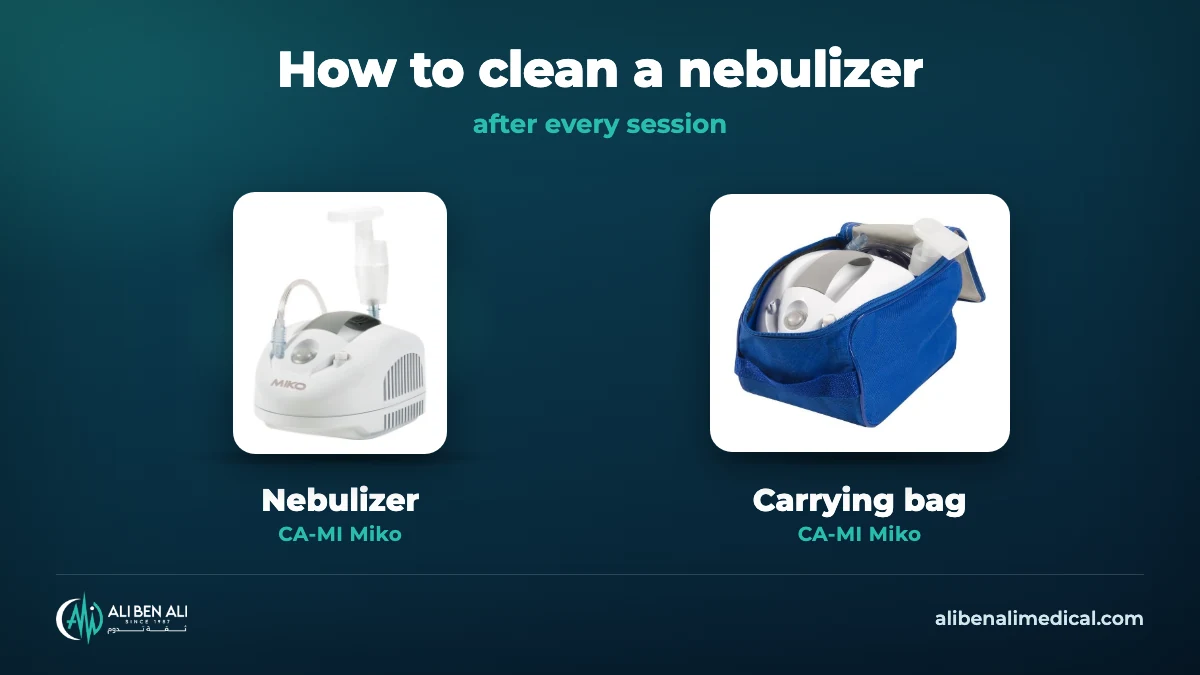
In winter a home nebulizer is used more than at any other time of year. The session ends, the unit goes back on the table as it is, the cup still holds a few drops of solution, and the tube is still attached. The question that follows is: how do I clean it, and how often?
This guide answers it step by step, using the instructions from the U.S. National Library of Medicine on MedlinePlus. It covers cleaning and storing the device only. The medicine, the dose and the length of a session are not its subject; your doctor decides those.
Why cleaning matters more than the motor
The compressor pushes air, and that air passes through the cup holding the solution and turns it into a mist that you breathe through the mask or mouthpiece. So the parts that touch your breath are the cup and the mouthpiece, not the motor. That is why cleaning focuses on them.
MedlinePlus says the aim of cleaning is to keep germs from growing inside the device, and that cleaning takes some time but keeps the device working well. And before any cleaning: unplug the device.
Cleaning is also the step many people find hardest. A systematic review published in 2021 looked at 16 studies on nebulizer use at home and found the main challenge users faced was cleaning and disinfecting the device (Sivadasan and colleagues, 2021). The authors suggested simple visual guides in everyday language alongside the manufacturer’s instructions.
After every session: 4 steps
A note before the steps: MedlinePlus describes three types of nebulizer. A jet nebulizer uses an air compressor to turn medicine into a mist, a mesh nebulizer passes it through a very fine mesh, and an ultrasonic nebulizer uses high-frequency vibrations. The steps below are for a device with a tube and a compressor; for any other type, follow its manufacturer’s instructions.
Cleanliness also starts before the session. The first step in MedlinePlus’s instructions for use is to wash your hands before you fill the cup.
These are the steps MedlinePlus lists after each use:
- Take the cup and the mouthpiece apart and wash them with warm running water.
- Let them air dry on clean paper towels.
- Once dry, reassemble and run air through the device for 20 seconds to make sure every part is dry.
- Take the parts apart and store the device covered until the next session.
If you use a mask instead of a mouthpiece, check the manufacturer’s instructions that came with the device for how to clean it; MedlinePlus says at the start that the device should be used according to the manufacturer’s instructions.
If you have trouble using or cleaning the device, MedlinePlus advises contacting your healthcare provider or the place you bought it from.
Daily, weekly and as needed
The four steps are the basis. MedlinePlus adds two more, on different schedules:
| When | What to do |
|---|---|
| After every session | Wash the cup and mouthpiece in warm running water, air dry them, run air for 20 seconds, and store the device covered |
| Once a day | You may add a mild dish soap to the same wash |
| Once or twice a week | You may also soak the cup and mouthpiece in a solution of 1 part distilled white vinegar to 2 parts warm water |
| As needed | Wipe the outside of the device with a warm, damp cloth |
| The filter | Change it on the schedule given in the device’s instructions |
Note that the vinegar and the soap are things you “may add”, as MedlinePlus words it, not a replacement for the warm-water wash. And the soak is for the cup and mouthpiece, as MedlinePlus writes it.
The tube and the filter: what not to wash
Three parts follow different rules from the cup:
- Do not wash the tube. MedlinePlus says it plainly: “Never wash the hose or tubing.”
- The filter gets changed. MedlinePlus says the instructions that come with the device tell you when, and the timing differs from one maker to another.
- The body of the device is wiped on the outside. Use a warm, damp cloth when needed, with the device unplugged.
Storage: dry and covered
The last cleaning step is storage, and MedlinePlus is specific: take the parts apart and store the device covered. The step before it, running air for 20 seconds, is there so that no drops of water are left inside.
Drying has a reason. A laboratory study published in 2022 worked with home nebulizers, including units used by people with cystic fibrosis, and found that bacteria on the surface of an unclean device can leave with the mist during a session, and more so when the device is stored in high humidity or not dried completely (Harris and colleagues, 2022). The researchers concluded that cleaning, disinfection and complete drying before storage are needed.
The Miko nebulizer: cup, bag and continuous running
An example of a nebulizer for home use is the CA-MI Miko nebulizer from Italy. According to its product page:
- The compressor is an oil-less piston type and runs continuously without needing to cool down between sessions.
- It has a HI-FLO cup, comes with adult and child masks with elastic, and a mouthpiece and nosepiece.
- The mist has a mass median aerodynamic diameter of 2.44 microns (MMAD), with over 80% of particles smaller than 5 microns, according to EN 13544-1.
- It weighs 1.45 kg and comes with a carrying bag for the unit and its accessories.
For cleaning, genuine CA-MI cups, masks and filters are available as spares, according to the product page. And if you store the parts in the bag, do it only once they are completely dry. The page itself says the doctor prescribes the medicine, the dose and the number of sessions, and that the device only turns medicine into a mist. The decision is your doctor’s.
To see other devices for the chest, here is the Pulmonology category. We have also written about World Asthma Day.
Frequently Asked Questions
No. MedlinePlus says never to wash the hose or tubing. What gets washed after each session is the cup and the mouthpiece.
MedlinePlus says to soak once or twice a week, in a solution of 1 part distilled white vinegar to 2 parts warm water. Once a day you may add a mild dish soap to the warm-water wash.
As the instructions that come with the device say, because the timing differs from one maker to another. For the Miko, genuine CA-MI filters are available from us; ask on WhatsApp or call 01212333328.
Yes, the CA-MI Miko nebulizer is registered with the Egyptian Drug Authority.
One year from Ali Ben Ali from the date of purchase, as stated on the product page. For any question about coverage, call the hotline on 01212333328.
References
- MedlinePlus (U.S. National Library of Medicine). How to use a nebulizer — medlineplus.gov/ency/patientinstructions/000006.htm
- Sivadasan S, Krishnan A, Dhayalan SV, Aiyalu R. A Systematic Review on KAP of Nebulization Therapy at Home. J Pharm Technol. 2021;37(5):254–259. PubMed PMID 34752576, doi:10.1177/87551225211031331 — PMC8404745
- Harris JC, Collins MS, Huang PH, et al. Bacterial Surface Detachment during Nebulization with Contaminated Reusable Home Nebulizers. Microbiol Spectr. 2022;10(1):e0253521. PubMed PMID 35107362, doi:10.1128/spectrum.02535-21 — PMC8809330
- Ali Ben Ali Medical Equipment. CA-MI Miko nebulizer product page — alibenalimedical.com
Medical devices are used in accordance with the treating physician’s instructions and the accompanying technical catalogue.
All devices are covered by the official warranty of Ali Ben Ali Medical Equipment.


