


Blog
ECG Machine Channels: 1, 3 or 12? What It Means
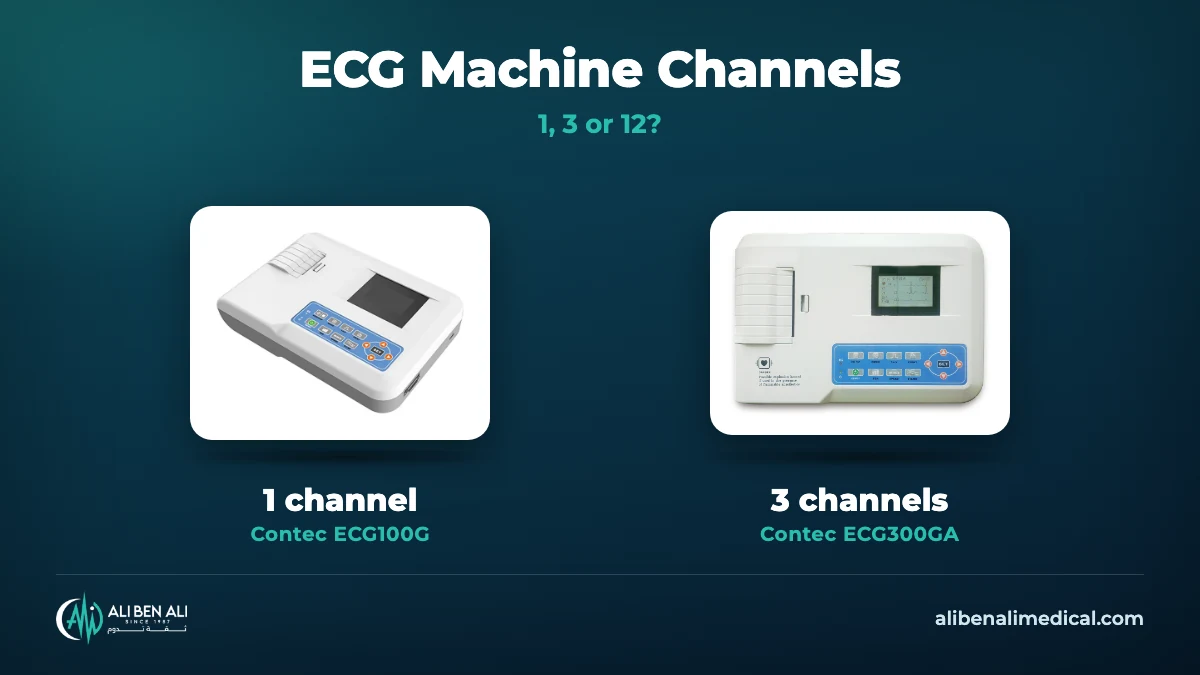
When you compare ECG machines, the first thing you meet is a number: 1 channel, 3 channels, 12 channels. It looks like a quality ranking, but it is not. It describes how many leads the machine prints at the same time, and it says little about the recording you end up with.
This article explains what an ECG records, what “12 leads” means, what a “channel” is, and which questions to ask before choosing a machine. The choice of a device is a decision for the treating doctor and the way the clinic works, so this is an explanation of terms, not a recommendation.
What does an ECG record?
An electrocardiogram, or ECG, records the electrical signals of the heart. According to the U.S. National Heart, Lung, and Blood Institute (NHLBI), small sensors called electrodes are placed on the chest, arms and legs, and they pick up the heart’s electrical activity and display it as a wave pattern.
MedlinePlus describes how the test goes (MedlinePlus): you lie down, electrodes are attached to the skin, and you stay still while the recording is made. The test is painless, and no electricity is sent into the body. The device only listens.
What does “12 leads” mean?
A standard ECG is called a 12-lead ECG. A lead is one view of the heart’s electrical activity, taken from a particular direction. Together the 12 leads look at the heart from several angles:
- limb leads, such as I and II, recorded from the electrodes on the arms and legs.
- chest leads, V1 to V6, recorded from electrodes placed across the chest.
A standard recording uses 10 electrodes in total, as set out by García-Niebla and colleagues in their review of lead placement. Placement matters: the same review explains that putting an electrode in the wrong position changes the shape of the waves. That is why clinics take care over where each electrode goes, and use single-use or skin-marked electrodes when a tracing has to be repeated at the same positions.
What is a “channel”?
Here is the point that confuses many buyers. A lead is a view of the heart. A channel is a line the machine prints, or displays, at the same moment. So the number of channels tells you how many leads are drawn together on the paper at one time.
- 1 channel: the machine prints one lead at a time.
- 3 channels: it prints three leads side by side.
- 12 channels: it prints all twelve together.
The product page of the Contec ECG100G puts it the same way: a single-channel machine prints one lead at a time, while 3- and 12-channel machines print several leads together, so the recording finishes faster. In other words, the channel count is mainly about how the leads are printed and how fast the recording is completed.
One channel: the Contec ECG100G
The Contec ECG100G is a single-channel machine. According to its product page:
- It weighs 1.5 kg and measures 315 × 215 × 77 mm.
- It prints on 50 mm thermal paper, and the printout carries the lead, sensitivity, speed and filter settings beside the waveform.
- It runs in automatic mode with one press, or in manual mode, at paper speeds of 25 and 50 mm/s.
- An LCD screen shows the waveform, with mains, baseline and EMG filters.
- The built-in lithium battery gives about 7 hours on standby, or 4 hours of continuous printing, or around 150 ECGs.
- It prompts you when a lead comes off or the paper runs out.
The page lists its uses as a first ECG in a clinic and home visits, and states that reading and interpreting the ECG is the physician’s responsibility.
Three channels: the Contec ECG300GA
The Contec ECG300GA collects all 12 leads at once and prints them on 3 channels, on 80 mm paper. Its product page lists:
- several print layouts, manual and automatic: 4×3, 3×4+1, 3×4, 2×6+1 and 2×6.
- a screen that shows the 12 leads together with the print mode, sensitivity, speed and filter.
- automatic measurements and a suggested interpretation, including heart rate, intervals such as P-R and Q-T, and the axes.
- internal memory for 15 cases, with transfer to PC software.
- a battery giving up to 8 hours of work, or 120 minutes of printing, or about 150 ECGs.
The page is clear that the automatic interpretation is an aid and that the diagnosis is the physician’s decision. A 2017 review in the Journal of the American College of Cardiology (Schläpfer and Wellens) agrees: computer interpretation still has limits in accuracy despite better software, and the tracing should be reviewed and confirmed by someone expert in reading ECGs. So these are automatic measurements for the doctor to review, not a substitute for the doctor.
And 12 channels?
A 12-channel machine prints all twelve leads together, on wider paper. What separates it from a 3-channel machine is the printing itself: the paper width and how many leads sit in each row. The standard recording is the same 12 leads in both cases.
A 12-channel Contec model is not available with us at the moment, so this article does not feature one.
Three questions to ask before you choose
The number of channels is not a ladder from worse to better. It is a choice that depends on how the clinic works, and three questions make it clearer:
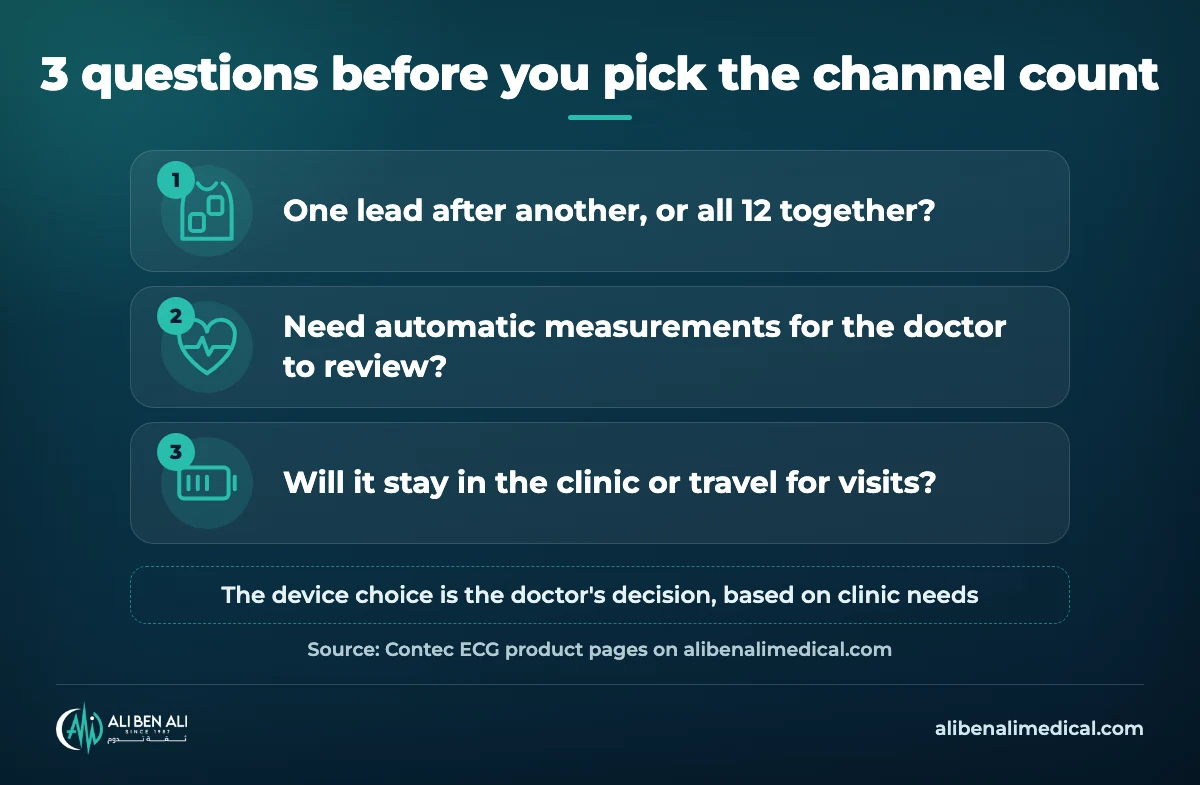
- One lead after another, or all 12 together? A single-channel machine prints one lead at a time. A machine like the ECG300GA collects all 12 leads at the same moment and prints them three to a row.
- Do you need automatic measurements for the doctor to review? The ECG100G page lists no automatic analysis. The ECG300GA produces measurements and a suggested interpretation, and the doctor reads and decides.
- Will it stay in the clinic, or travel for visits? Both machines weigh 1.5 kg and run on mains or battery. They differ in battery life and printing time, as each page states.
In the end, the choice is the doctor’s decision and depends on the needs of the clinic.
How to get a clear tracing
Whatever the number of channels, the tracing depends on how the recording is made. MedlinePlus gives a few simple points:
- The person should stay still, relaxed and warm, because any movement, even shivering from cold, can change the result.
- No exercise or cold drinks right before the tracing, because they can give wrong results.
- The doctor should know every medicine the person takes, because some medicines can affect the result.
- Sometimes hair is shaved or trimmed where the electrodes go, so they stick well.
MedlinePlus also notes that a heart problem may not always show on an ECG. So the tracing is one part of the examination, and the doctor links it to the rest of the picture.
Frequently asked questions
A lead is one view of the heart’s electrical activity. A channel is a line the machine prints at the same moment. A 3-channel machine prints three leads together, while still being able to record all twelve.
According to the ECG100G page, it prints one lead at a time, with the lead name, sensitivity and speed beside each waveform. A machine like the ECG300GA collects the 12 leads together. Which approach to use is the doctor’s decision.
A standard 12-lead recording needs 10 electrodes in the right positions, according to the review by García-Niebla and colleagues (2009).
No. According to the product page, the machine measures and proposes an interpretation, and the final diagnosis is the physician’s decision.
The Contec ECG100G and ECG300GA each carry a two-year warranty from Ali Ben Ali from the date of purchase, according to their product pages. For any question, call our hotline on 01212333328.
References
- MedlinePlus (U.S. National Library of Medicine). Electrocardiogram — medlineplus.gov/ency/article/003868.htm
- National Heart, Lung, and Blood Institute (NIH). Heart tests — nhlbi.nih.gov/health/heart-tests
- García-Niebla J, et al. Technical mistakes during the acquisition of the electrocardiogram. Ann Noninvasive Electrocardiol. 2009;14(4):389–403. PubMed PMID 19804517 — full text on PubMed Central
- Schläpfer J, Wellens HJ. Computer-Interpreted Electrocardiograms: Benefits and Limitations. J Am Coll Cardiol. 2017;70(9):1183–1192. PubMed PMID 28838369 — doi:10.1016/j.jacc.2017.07.723
- Ali Ben Ali Medical Equipment. Contec ECG100G single-channel ECG product page — alibenalimedical.com
- Ali Ben Ali Medical Equipment. Contec ECG300GA 3-channel ECG product page — alibenalimedical.com
Medical devices are used in accordance with the treating physician’s instructions and the accompanying technical catalogue.
All devices are covered by the official warranty of Ali Ben Ali Medical Equipment.