


Blog
Suction Machine Capacity: 1, 2, 4 or 10 Litres?
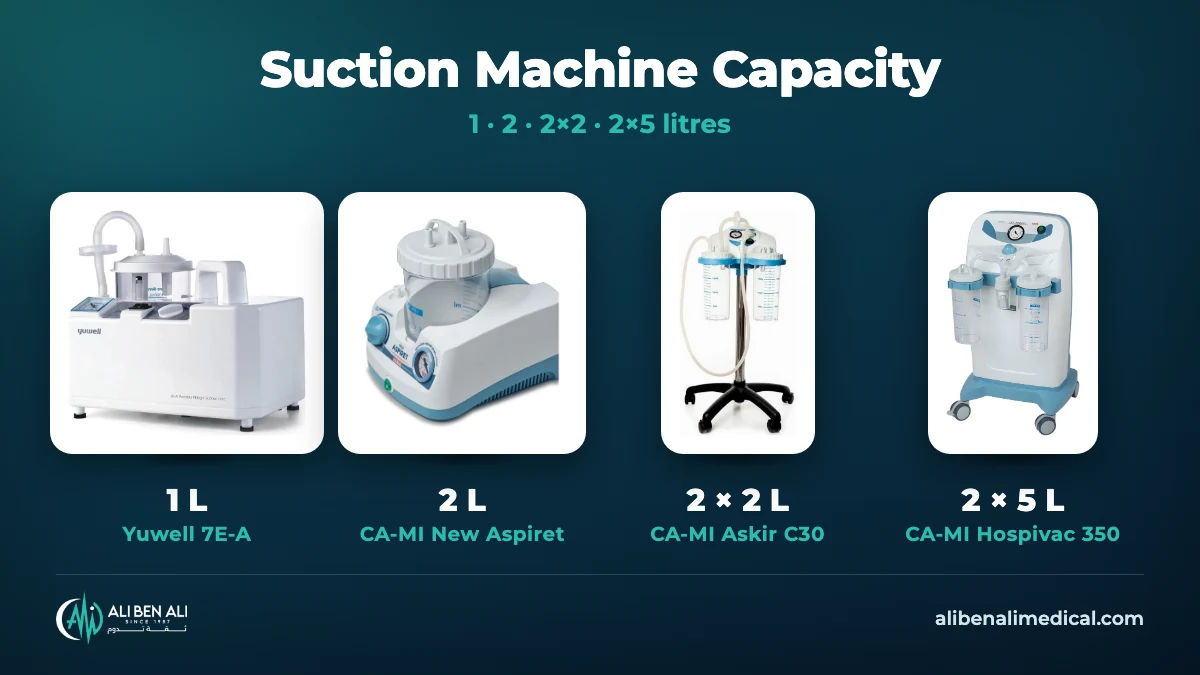
Medical suction machines are listed by a number in litres: 1, 2, 4, 10. It is the first figure a buyer sees, and the easiest to misread. That number is the size of the collection jar, not the strength of the pump, and it says a lot about where a unit is meant to work.
This guide walks through what a medical suction unit does, then the three settings it is bought for: care at home, the clinic and minor surgery, and the operating theatre. Every specification here comes from the product pages of the units we carry. It does not teach suctioning technique. That is clinical practice, and it is taught by the care team.
What a medical suction unit does
An electric suction unit creates a vacuum that draws fluid through a tube into a collection jar. The product pages for the units below describe the same core use: aspirating body fluids and secretions, including oral, nasal and tracheal aspiration.
Four parts matter when you compare units:
- The collection jar. This is the litre figure. A larger jar holds more before it has to be emptied.
- The pump. It sets how hard the unit pulls (in kPa) and how fast it moves air, quoted in litres per minute (L/min).
- The vacuum indicator and regulator. They let the operator see and set the suction level.
- The safety parts. Overflow protection on the jar, and a filter in front of the pump.
Capacity and pump flow are separate specifications. The New Aspiret’s 2 L jar comes with 15 L/min, the Askir C30, with two 2 L jars, is rated at 40 L/min, and the New Hospivac 350, with two 5 L jars, at 60 L/min. A bigger jar does not by itself mean a stronger pump, so read both lines of the spec sheet.
| Unit | Jar capacity | Pump and suction | Form | Setting named on the page | Warranty |
|---|---|---|---|---|---|
| Yuwell 7E-A | 1 L (1000 mL) | Oil-free pump, 85 kPa, at least 20 L/min | Portable, about 4 kg | Emergency and home use; phlegm and viscous fluids | 1 year |
| CA-MI New Aspiret | 2 L | Oil-less piston pump, up to -75 kPa, 15 L/min | Desk-type with carrying handle, 2.2 kg | Home care, wards, tracheostomy, ENT, post-operative and minor surgery | 2 years |
| CA-MI Askir C30 | 2 × 2 L jars | Oil-less piston pump, up to -80 kPa, 40 L/min | On a 5-castor stand, 6.2 kg | General surgery, gynaecology, dental practice; adults and children | 2 years |
| CA-MI New Hospivac 350 | 2 × 5 L jars | Oil-less piston pump, up to -90 kPa, 60 L/min | On castors, 13 kg | Operating theatre, general surgery, emergency department | 2 years |
Home care: tracheostomy and after an operation
Some patients go home with a tracheostomy tube. MedlinePlus, from the U.S. National Library of Medicine, lists suctioning the tube among the things the care team teaches before the patient leaves hospital, together with cleaning and replacing it. Its tracheostomy care page also tells patients to contact their provider if there is too much mucus that is hard to suction or cough up, or if coughing or shortness of breath continues even after suctioning.
That is the line this article keeps: when, how often and how deep to suction is decided and taught by the care team, not by a buyer’s guide.
What a home unit needs is on the spec sheet. The CA-MI New Aspiret is a 2-litre desk-type unit with a carrying handle. Its page says it is made for nasal, oral and endotracheal aspiration of secretions in adults and children, at home, on wards, after surgery and in minor surgery, and lists tracheostomy among its uses. Suction goes up to -75 kPa, adjustable by a regulator, from an oil-less, maintenance-free piston pump, and the unit can run non-stop without a cool-down. The page gives its free flow as 15 L/min, classed as high vacuum and low flow, which it describes as suited to secretions and small volumes. It also lists an IP21 rating, an antibacterial hydrophobic filter, and an autoclavable, reusable jar and tubes.
The Yuwell 7E-A also lists home use. Its page describes a small, light phlegm suction unit for emergency and home, about 4 kg, with 85 kPa of suction and at least 20 L/min. The doctor or nurse sets the suction level.
Clinic and minor surgery
A clinic often needs something that sits on a counter and moves between rooms. The Yuwell 7E-A is the smallest unit here: a 1-litre jar with an overflow valve that stops suction by itself when the jar is full, followed by an air filter, and a vacuum indicator with a knob that sets suction from 20 kPa to maximum vacuum. Its page also lists an oil-free pump and a 30-minutes-on, 30-minutes-off duty cycle.
When the jar has to hold more, or the unit has to roll to the patient, the CA-MI Askir C30 steps up. It carries two 2 L collection jars on a stand with five castors, with a foot switch that starts and stops suction. Its page rates suction up to -80 kPa and 40 L/min from an oil-less piston pump that runs non-stop, with an overflow-protected jar cover, an antibacterial hydrophobic filter, and autoclavable silicone tubes. The page lists general surgery, gynaecology, dental work, and nasal, oral and endotracheal aspiration in adults and children.
Theatre-grade units: 10 litres
In theatre, volume and flow both go up. The CA-MI New Hospivac 350 has two 5 L jars (10 litres of collection, as its page puts it), suction up to -90 kPa and a 60 L/min oil-less piston pump that runs non-stop. Its page describes an operating-theatre unit, and lists general surgery, the emergency department, gynaecology, obstetrics, neurosurgery and dental practice among its specialties.
Three features on its page are about running a theatre rather than suction itself:
- Jar change-over without stopping suction: when one jar fills, soft-touch keys move suction to the other.
- Protection for the pump: three systems against internal reflux, an overflow-protected jar cover, a 220 mL safety trap bottle and an antibacterial hydrophobic filter.
- A foot switch for intermittent or continuous operation, keeping the surgeon’s hands free.
For the full range, from portable phlegm units to theatre units, see our suction units category.
Oil-less pumps and filters
All four units here run on a pump without oil: the New Aspiret, the Askir C30 and the New Hospivac 350 use an oil-less piston pump, and the Yuwell 7E-A page lists an oil-free pump. As the names say, the pump runs without oil.
Filters and jars are the parts that touch what is drawn in. The Yuwell 7E-A page lists an overflow valve followed by an air filter, and the CA-MI pages list an overflow-protected jar cover with an antibacterial hydrophobic filter. The CA-MI jars are autoclavable and reusable, and they are also sold on their own: CA-MI autoclavable suction jars, in 2000, 4000 and 5000 mL, with the Makrolon polycarbonate jar autoclavable up to 121 °C.
Which unit a department needs depends on the procedures it runs and on its clinicians’ protocols. Professional guidance on the clinical side exists and is specific: the American Association for Respiratory Care’s clinical practice guideline on endotracheal suctioning of mechanically ventilated patients reviewed 114 clinical trials, 62 reviews and 6 meta-analyses. Technique belongs to that guidance and to the care team. The choice is your clinical team’s.
Frequently asked questions
It is the capacity of the collection jar: 1 litre on the Yuwell 7E-A, 2 on the New Aspiret, two 2-litre jars on the Askir C30, and two 5-litre jars on the New Hospivac 350. It is not the pump’s strength.
Not by itself. Pump flow is a separate figure in L/min. On our pages the New Aspiret is rated at 15 L/min, the Askir C30 at 40 L/min and the New Hospivac 350 at 60 L/min.
The New Aspiret’s page lists home care, tracheostomy and post-operative use, and the Yuwell 7E-A’s page lists emergency and home use. How and when to suction is taught by the care team.
The pump runs without oil. The New Aspiret, the Askir C30 and the New Hospivac 350 use an oil-less piston pump, and the Yuwell 7E-A page lists an oil-free pump.
All four pages list a filter: an air filter after the overflow valve on the Yuwell 7E-A, and an antibacterial hydrophobic filter on the CA-MI units. The overflow valve or overflow-protected jar cover is a separate safety part.
Per each product page: 2 years from Ali Ben Ali on the New Aspiret, Askir C30 and New Hospivac 350, and 1 year on the Yuwell 7E-A, from the date of purchase. For any question, call our hotline on 01212333328.
References
- American Association for Respiratory Care. AARC Clinical Practice Guidelines. Endotracheal suctioning of mechanically ventilated patients with artificial airways 2010. Respir Care. 2010;55(6):758–64. PubMed PMID 20507660 — pubmed.ncbi.nlm.nih.gov/20507660
- MedlinePlus (U.S. National Library of Medicine). Tracheostomy care — medlineplus.gov/ency/patientinstructions/000076.htm
Medical devices are used in accordance with the treating physician’s instructions and the accompanying technical catalogue.
All devices are covered by the official warranty of Ali Ben Ali Medical Equipment.