

Blog
CPAP Mask Types: Nasal, Full Face or Nasal Pillows?
A CPAP machine sits on the bedside table. The mask sits on your face all night. A cushion that leaks at the edge, a strap that presses, or a frame that shifts every time you turn over can wear on you even when the device is running exactly as set.
This guide explains the three main CPAP mask types, the signs of a poor fit, and when to replace a mask. It does not prescribe: type and size are settled with your doctor or respiratory therapist.
The mask is the part that touches you all night
A CPAP device delivers air at a set pressure, or an automatically adjusted one on an Auto CPAP, and the mask carries that pressure to your airway. The mask is not a treatment in itself. Its job is to seal without pressing too hard, and to let exhaled air out through its vents.
The U.S. National Heart, Lung, and Blood Institute (NHLBI) describes the system as a motor, a tube, straps, and a mask over the nose or over the nose and mouth. It also notes that getting used to CPAP takes time and patience, and that your healthcare provider will work with you to find a comfortable mask.
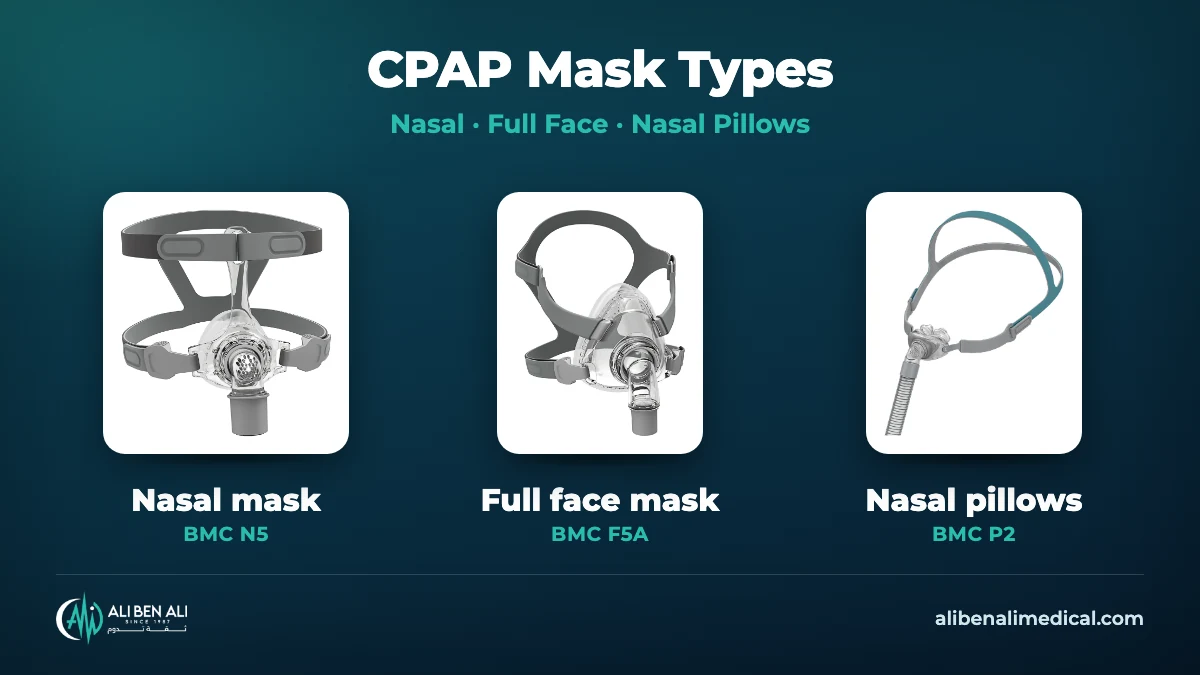
There are three shapes: nasal mask, full face mask and nasal pillows. They differ in how much of the face they touch, their rated pressure range, and their sizes.
The nasal mask: who it is for, and how it seals
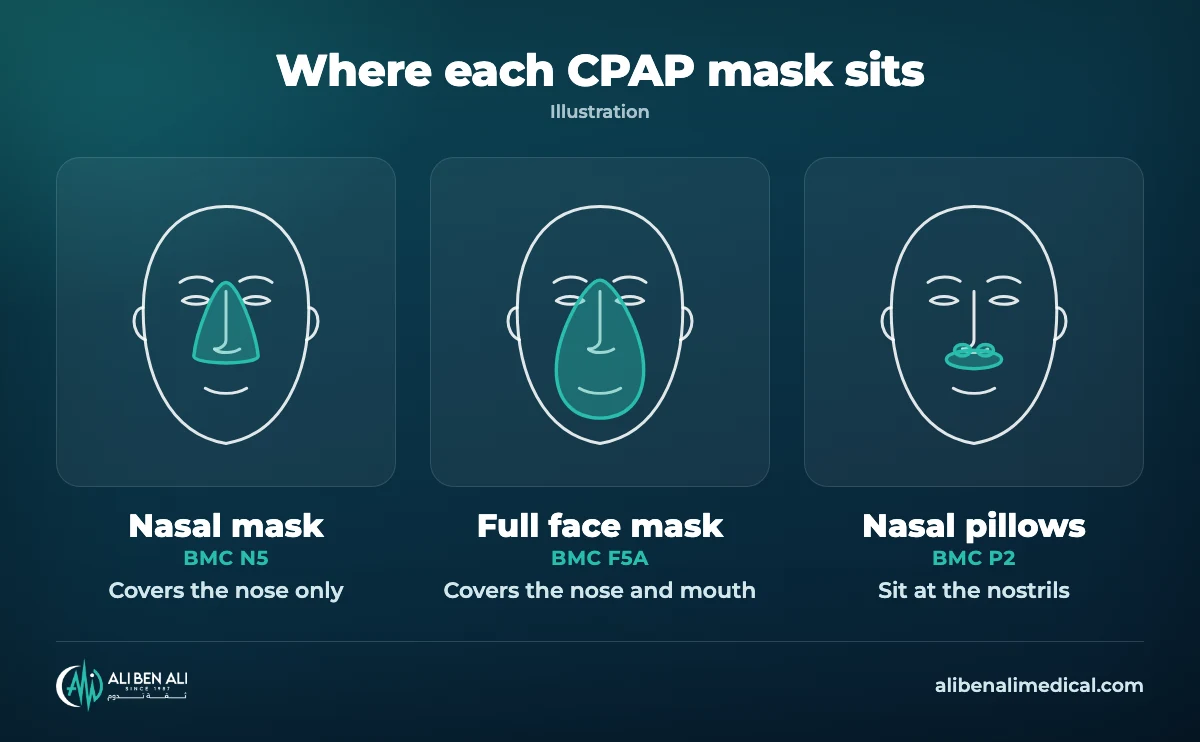
A nasal mask covers the nose only. A silicone cushion sits around the nose, and the mouth stays outside the mask. The BMC N5 nasal mask is one example. It is made for CPAP and BiPAP devices at therapy pressures from 4 to 25 cmH₂O, has a dead space under 125 mL (the volume of air held inside the mask between breaths), measures 20 dBA sound pressure at one metre. We stock it in sizes M and L.
The seal comes from the right size and evenly adjusted straps. BMC’s user manual is direct: adjust the headgear until the mask feels comfortable and firm, and do not over-tighten. Pulling harder does not buy a better seal; it presses the cushion out of shape.
The full face mask: nose and mouth together
A full face mask (also called an oronasal mask) covers the nose and mouth together. It is larger than a nasal mask and rests on more of the face.
The BMC F5A full face mask is rated for therapy pressures from 4 to 40 cmH₂O, the widest range of the three BMC masks we carry. It has an anti-asphyxia valve that opens if airflow stops or is blocked. BMC describes a groove in the cushion that adapts to the bridge of the nose to keep leakage and facial pressure low, and a design with no forehead frame for a wider field of vision. BMC makes it in S, M and L; we stock M and L.
Which type is prescribed depends on the person’s condition and therapy pressure. The choice is your doctor’s.
Nasal pillows: how they sit, and their sizes
Nasal pillows work differently. Instead of a cushion around the nose, two small silicone pillows sit at the entrance of the nostrils. BMC describes the P2 nasal pillows mask as light, flexible and quiet, designed to minimise contact with the face. It is rated for therapy pressures from 4 to 20 cmH₂O, is the quietest of the three at 18 dBA at one metre, and the pillows come in three sizes: S, M and L.
BMC’s manual states that the P2 is for adults over 30 kg who have been prescribed CPAP or bi-level therapy. Which type suits you is your doctor’s choice.
There is also a large study that compared the three types directly. A network meta-analysis by Chen and colleagues, published in the Journal of Sleep Research in 2022, pooled 29 studies with 6,378 participants with obstructive sleep apnoea. In that analysis, nasal masks and nasal pillows were associated with higher CPAP adherence and lower required CPAP pressure than oronasal (full face) masks. That is a finding across groups of patients, not a verdict on any one person. The choice is your doctor’s.
| Type | Covers | Works with | Pressure range | Sizes | Warranty |
|---|---|---|---|---|---|
| Nasal mask · BMC N5 | Nose only | CPAP and BiPAP (bi-level) | 4 – 25 cmH₂O | M · L | 1 year |
| Full face mask · BMC F5A | Nose and mouth | CPAP and BiPAP (bi-level) | 4 – 40 cmH₂O | M · L | 1 year |
| Nasal pillows · BMC P2 | At the nostrils | CPAP and BiPAP (bi-level) | 4 – 20 cmH₂O | S · M · L | 1 year |
Leaks and sizing: signs a mask is not fitting right
Air leaving through the vents is normal: that is your exhaled air. The leak worth attention is air escaping around the cushion. Signs the fit needs a second look:
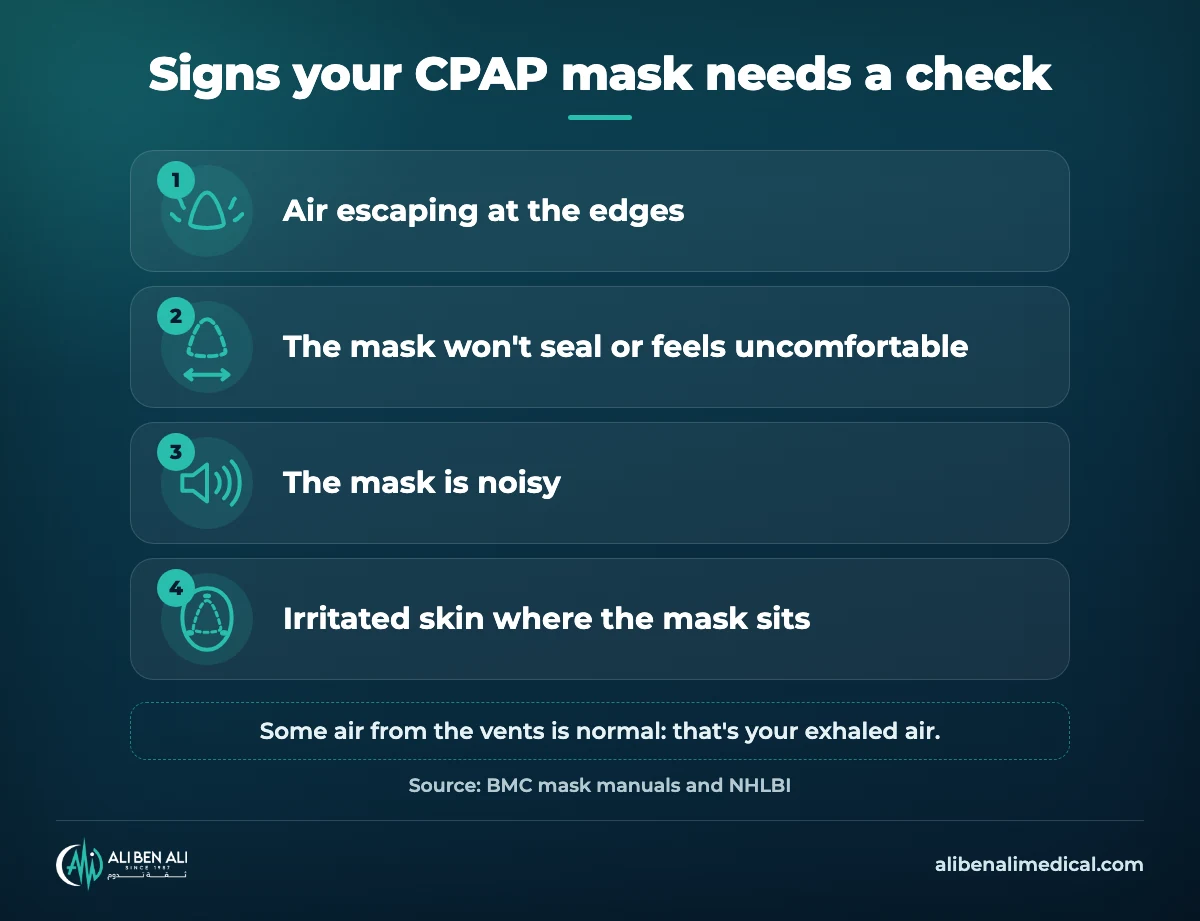
- You can feel air escaping at the edges. With nasal pillows, BMC’s P2 manual says to readjust the angle of the pillows first; if the leak persists, you may need a different pillow size.
- The mask will not seal, or is uncomfortable. The N5 manual names three causes: incorrect fitting, over-tightened headgear, or the wrong size, for which it says to consult your clinician.
- The mask is noisy. The straps may not be adjusted correctly, or the cushion may be out of position.
- Your skin is irritated where the mask sits. NHLBI notes some masks can cause irritation, and your healthcare provider can help relieve it.
One safety point from the mask pages: wear the mask only while the device is on and blowing air, because the vents need airflow to clear exhaled air. If the device stops or the power cuts, take the mask off. Keep the vents clean and unblocked.
BMC advises replacing the mask within 12 months of first use, or sooner if a part cracks or tears. Clean it daily by hand in water at 25–35 °C with a mild detergent (no bleach, alcohol or scented products) and dry it away from sunlight.
Your device comes with a mask, and you choose the type
The product page for the BMC G3 A20 Auto CPAP states that a mask is included with the device. The mask type (nasal, full face or nasal pillows) is set when you order, and our sales team confirms the size with you on WhatsApp or by phone before shipping. The choice is your doctor’s.
The G3 A20 also reminds you to replace the mask, tubing and filter every 30, 60, 180 or 365 days. If you are still comparing the machines themselves, see our article on the difference between Auto CPAP and BiPAP home devices.
Frequently asked questions
A nasal mask covers only the nose; a full face mask covers nose and mouth. The BMC N5 is rated up to 25 cmH₂O; the F5A up to 40 cmH₂O, with an anti-asphyxia valve. The choice is your doctor’s.
BMC’s manual and our product page list the P2 for CPAP and bi-level (BiPAP) devices at 4 to 20 cmH₂O. Your doctor or respiratory therapist checks it against your device and settings.
We stock the N5 and F5A in M and L; the P2 pillows come in S, M and L. Our sales team confirms the size before shipping. If a correctly fitted mask still leaks or feels uncomfortable, you may need another size; your doctor or respiratory therapist can help.
Within 12 months of first use, per BMC, or sooner if a part cracks or tears. The G3 A20 can remind you when it is due.
No. Wear the mask only while the device is running and blowing air. If the device stops, take the mask off.
All three BMC masks carry a one-year warranty from Ali Ben Ali from the date of purchase. For any question, call our hotline on 01212333328.
References
- Chen LY, Chen YH, Hu SW, et al. In search of a better CPAP interface: A network meta-analysis comparing nasal masks, nasal pillows and oronasal masks. J Sleep Res. 2022;31(6):e13686. PubMed PMID 35821391 — doi:10.1111/jsr.13686
- National Heart, Lung, and Blood Institute (NIH). CPAP — nhlbi.nih.gov/health/cpap
- National Heart, Lung, and Blood Institute (NIH). Sleep Apnea — nhlbi.nih.gov/health/sleep-apnea
- BMC Medical. CPAP products — en.bmc-medical.com/cpap-products
- BMC Medical. P2 Nasal Pillows Interface — en.bmc-medical.com · user manual — PDF
- BMC Medical. N5 Nasal Mask — en.bmc-medical.com · user manual — PDF
- BMC Medical. F5A Full Face Mask — en.bmc-medical.com · user manual — PDF
Breathing and respiratory support devices are used under the supervision of a specialist physician.
Medical devices are used in accordance with the treating physician’s instructions and the accompanying technical catalogue.
All devices are covered by the official warranty of Ali Ben Ali Medical Equipment.


